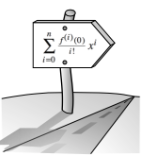
12.1.5Is there a shortcut for writing a Taylor series?

Building Taylor Series Using Substitution

12-48.

Write the first four terms and the general term of the Maclaurin series for y=cos(x)y=sin(x), and y=ex. Refer back to previous problems to help you do this efficiently.

12-49.

The Maclaurin series that you wrote for y=cos(x) in problem 12-48 can help you write other Maclaurin series quickly.

  1. Consider the equations y=cos(2x) and y=cos(x). Use substitution to write a Maclaurin series for f(x)=cos(2x).

  2. Likewise, use substitution to write a Maclaurin series for f(x)=cos(x2).

12-50.

Use substitution to write the first four terms and the general term of the Maclaurin series for each of the functions below.

  1. f(x)=cos(x) 

  2. g(x)=ex 

  3. h(x)=sin(x2) 

12-51.

Without knowing the antiderivative of y=ex2, the definite integral 01ex2dx is difficult to evaluate without a calculator. You can, however, approximate the value of the integral by integrating a Taylor polynomial for y=ex2.

  1. Use the first three non-zero terms of the Maclaurin series for y=ex2 to write a fourth-degree Taylor polynomial, p4(x), centered at x=0.

  2. Approximate the value of 01ex2dx by integrating the polynomial from part (a) on the interval [0,1].

  3. Use a calculator to evaluate 01ex2dx and compare this value to your answer from part (b). What is the error of your approximation?

12-52.

Use the Maclaurin series for sin(x) to demonstrate that limx0sin(x)x=1.

12-53.

For x near 0, use the Maclaurin series for cos(x) to demonstrate that limx01cos(x)x=0.

12-54.

Use a Taylor series to evaluate cos(x2)1x2dx.

Review and Preview problems below

12-55.

Compare the Maclaurin series for f(x)=sin(x) and g(x)=cos(x). Homework Help ✎

  1. Use what you know about f and g to find a way that will help you remember which the expanded forms of each function.

  2. Since ddxsin(x)=cos(x), Khalel thinks the polynomial approximations of these functions should work the same way. Test his theory.

12-56.

Write the equation of the third-degree Taylor polynomial, p3(x), about x=1 for f(x)=x. Then use substitution to write a sixth-degree Taylor polynomial for f(x)=x2+1. Homework Help ✎

12-57.

The graph at right shows the derivative of y=f(x). Give approximate answers to the questions below and justify your responses. Homework Help ✎

  1. For what value(s) of x does f attain a relative minimum?

  2. At what value(s) of x does a critical point that is neither a relative maximum nor a relative minimum exist?

  3. For what values of x is the graph of y=f(x) concave up?

Continuous curve labeled, f prime of x, coming from upper left, passing through (negative 4, comma. 0), turning at approximate points, (negative 3, comma negative 3), at the origin, & @ (2, comma negative 1), passing through (3, comma 0), continuing up & right.

12-58.

Calculate the volume of the solid formed by revolving the region bounded by the y-axis, the graph of f(x)=4x3/2+1, and the line y=12 about the y-axis. Homework Help ✎

12-59.

If the solid in problem 12-58 is a storage tank and liquid is being added at a rate of 8 cubic units per minute. How fast is the level of the liquid in the tank rising when the level is 4 units above the lowest point of the tank? Homework Help ✎

12-60.

Multiple Choice: If dydx=log2(y2+1) , then d2ydxx=  Homework Help ✎

  1. 2yy2+1 

  1. 1ln(2)2yy2+1 

  1. 2yy2+1log2(y2+1) 

  1. 1ln(2)2yy2+1log2(y2+1) 

  1. ln(2)2yy2+1log2(y2+1) 

12-61.

Multiple Choice: Use your calculator to compute the error of the sixth-degree Taylor polynomial approximation of y=ex2 centered at x=0.5. Homework Help ✎

  1. 0.17216 

  1. 0.50538 

  1. 0.00015 

  1. 0.19027 

  1. 0.09894